Today we will discuss different states of consciousness. We will see how our day-to-day way of being is in fact unconsciousness. We will conclude by saying how, through certain practices, we can enter something called the 3rd state of consciousness.
Perhaps during a moment of great danger or of great importance (such as a child being born), you “zoomed out”, felt everything much more clearly, and remembered every detail. Time around you seemed to stop. What happened is that the intensity of such an experience provoked within you a heightened level of perception, where the mind ceased activity while the consciousness was in great activity. These states show us that such an alertness is an organic state of our being and is accessible to us.
Unfortunately, what happens is that soon after these experiences we resume our “normal” state of being. When we truly investigate it, this “normal” state of being is actually profound sleep. We can feel that normally, life feels very mechanical; we rarely have moments of deep realisations, and reality feels rather flat. We leave our keys in all the wrong places or walk into rooms without knowing what we wanted to grab. This is also reflected in our psychology. We make the same mistakes over and over again. We hurt people; we hurt ourselves.
Without endless distractions, life feels dull and repetitive and like one big Groundhog Day. This is sleep. All of our essentially limitless energy goes into fulfilling the same patterns we have executed for years and years, akin to machines. The faculty of consciousness is simply turned off. With it in activity, which is beyond time, we perceive everything as new, as profound and endlessly inspiring. But within us we possess the innate ability to trigger this state of consciousness and perceive everything with almost magical rawness, definition, novelty, and meaning. Every moment we are in that state is a moment of life that we have reclaimed from the otherwise mechanical churning of reality.
Samael Aun Weor1 taught that there are 4 states of consciousness.
- SLEEP (Eurasia)
- VIGIL (PISTIS)
- SELF-CONSCIOUSNESS (DIANOIA)
- OBJECTIVE CONSCIOUSNESS (NOUS/TURIYA)
Sleep is simply the deepest state of unconsciousness which we enter into when our physical body goes into rest. We have absolutely no recollection of the events from that moment, and even though there is inner activity at that time, there is absolutely no memory or agency over it. We are completely unconscious. It is like a deleted tape in the archive of our life.
Vigil is the type of consciousness that most of us are in 99% of the time, save for these moments of great danger or importance. It is the most deceiving, because we have our eyes opened, we “perceive” the reality around us, and yet we are in essence mechanical. We execute the programmes within, which are driven by desires and aversions. Life feels 2-dimensional. In comparison to a true state of presence, this level of awareness is an illusion. Of course there are degrees and degrees of it. We can be almost completely unaware, for example, walking straight into a wall, or more aware. However, we are not SELF-aware. It is as if we are going down a slide. There is little to no true control of our reality. We simply go along with it. We take life for granted. We assume things are the way they are because… they are the way they are.
Self-consciousness constitutes a profound shift in these stages of awareness. It is as if the baby finally recognises itself in the mirror, but on a much deeper and profound level. It is the realisation that one is. Here also there are layers and layers and different states. But the basis of it is that the person is conscious of his own existence in a profound way. He does not identify with the body he has, the voice he has, or the “person” he is. He tunes into the “field” of consciousness, perceiving the person we are and the environment as one, so to speak. He observes the phenomenon of personhood in this physical world as something separate from his true nature as an immortal being. He has a simultaneous awareness of what is going on inside and what is going on outside. This state can be felt in many different ways. In some people it is as if there is something watching them from inside and simultaneously from behind and on top of the head. For others it feels like a little person driving their vehicle from their heart.
How do we trigger this?
We do it through moment-to-moment awareness. This is best anchored in the heart (if we go into the heart, we can feel how it suspends the feeling of the passage of time). We can strengthen this by practising (as often as we remember) an excellent technique brought forth by Samael Aun Weor, called the KEY OF SOL.
The Key of SOL breaks down into three questions which we ask ourselves and answer instantaneously, not with the mind but with experience.
SUBJECT: Who am I? (Relate this to the deepest part of you: who are you really?) [This is something that we have to meditate on].
OBJECT: What am I doing? (Simply observe what your body, mind, and emotions are doing. We do not answer this with any concepts; we simply observe.)
LOCATION: Where am I? (We start with extending our peripheral vision, but really this is about using the consciousness to envelop our surroundings while simultaneously holding the awareness of ourselves).
In essence, we simultaneously hold inside and outside awareness.
(This is not trying to trigger an out-of-body experience where the consciousness simply leaves the body.)
The more we do this, the more we create an inner oscillation of this higher frequency of the third state of consciousness. Eventually all we might have to do is to simply tune back into it. But this takes time, will and energy (how we conserve and release inner energy is a huge topic that will be addressed but can also be read here). It also takes perseverance and simply coming back to it again and again. We can use alarm clocks or phone notifications to be reminded (there are many such apps for iOS and Android). We can have little drawings and notes around our house, a bracelet or anything else that reminds us to be in the here and now. Very soon we will be able to taste the unbelievable novelty of the experience, and it will become natural for us to return to that state (or at least want to return to it). But something more profound happens. It is as if an inner birth happens. The moment we disidentify from our sense of self, we realise we are immortal divinity experiencing itself. Seems too easy to be true, but it is not. If we go beyond the illusion of time, and in the present moment there is no time, we taste the immortality of our essence. We come to realise we are not any of our problems, our thoughts, our emotions, or our body. Rather, we have a mortal vehicle for an immortal experience. To truly experience this is to experience an essential liberation from a conditioning of our life that is an illusion. Our aliveness is not at all connected to the life of our physical body. It is, however, directly related to the amount of consciousness we activate and use.
Another way of seeing the four states of consciousness is through the example of a character in a video game.
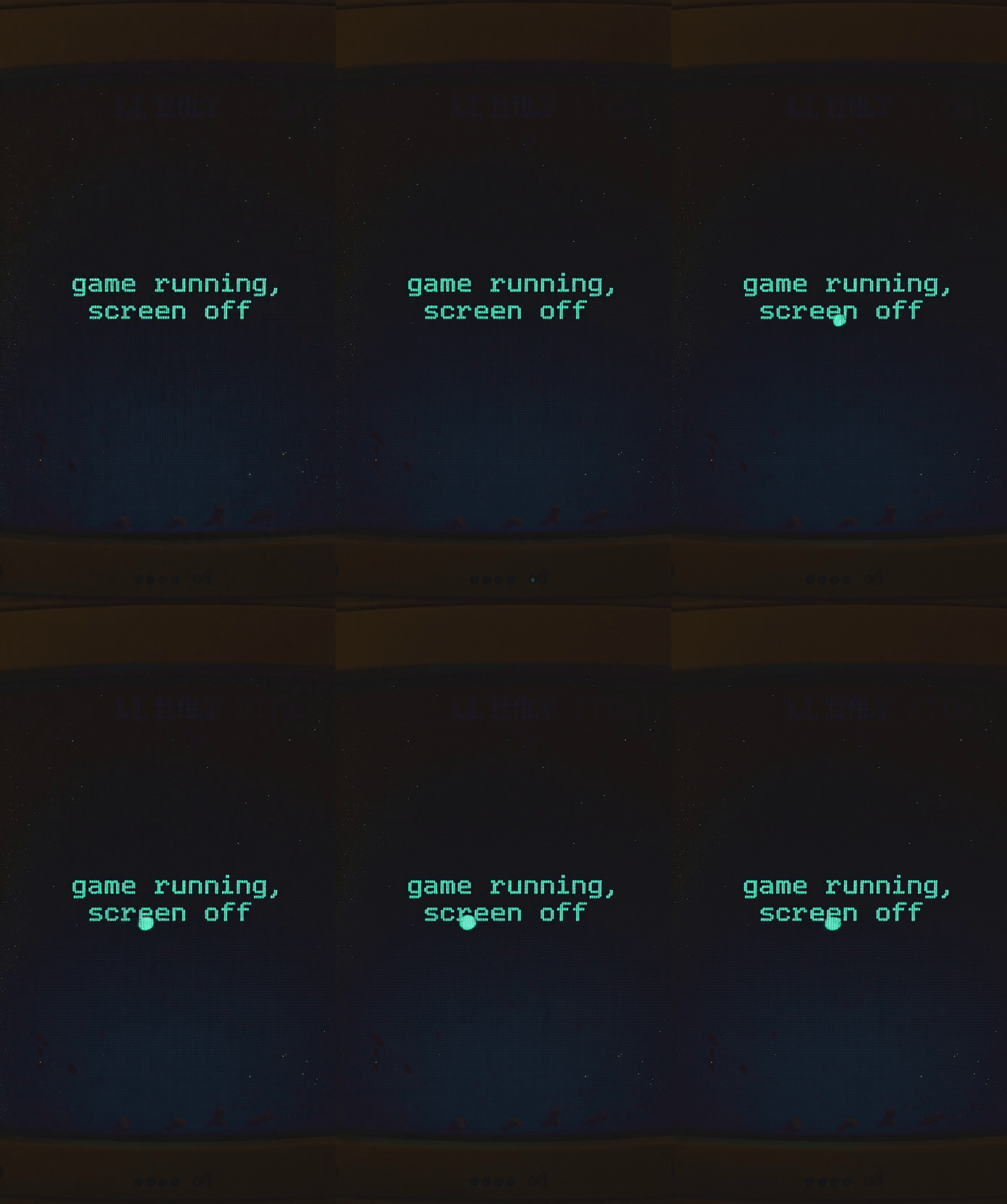
In the first state, sleep, the game is running, but the screen is off, and we don’t know what is going on. Things are simply happening. We may be doing horrible things with our character, creating harm, etc., but we have no awareness of it.
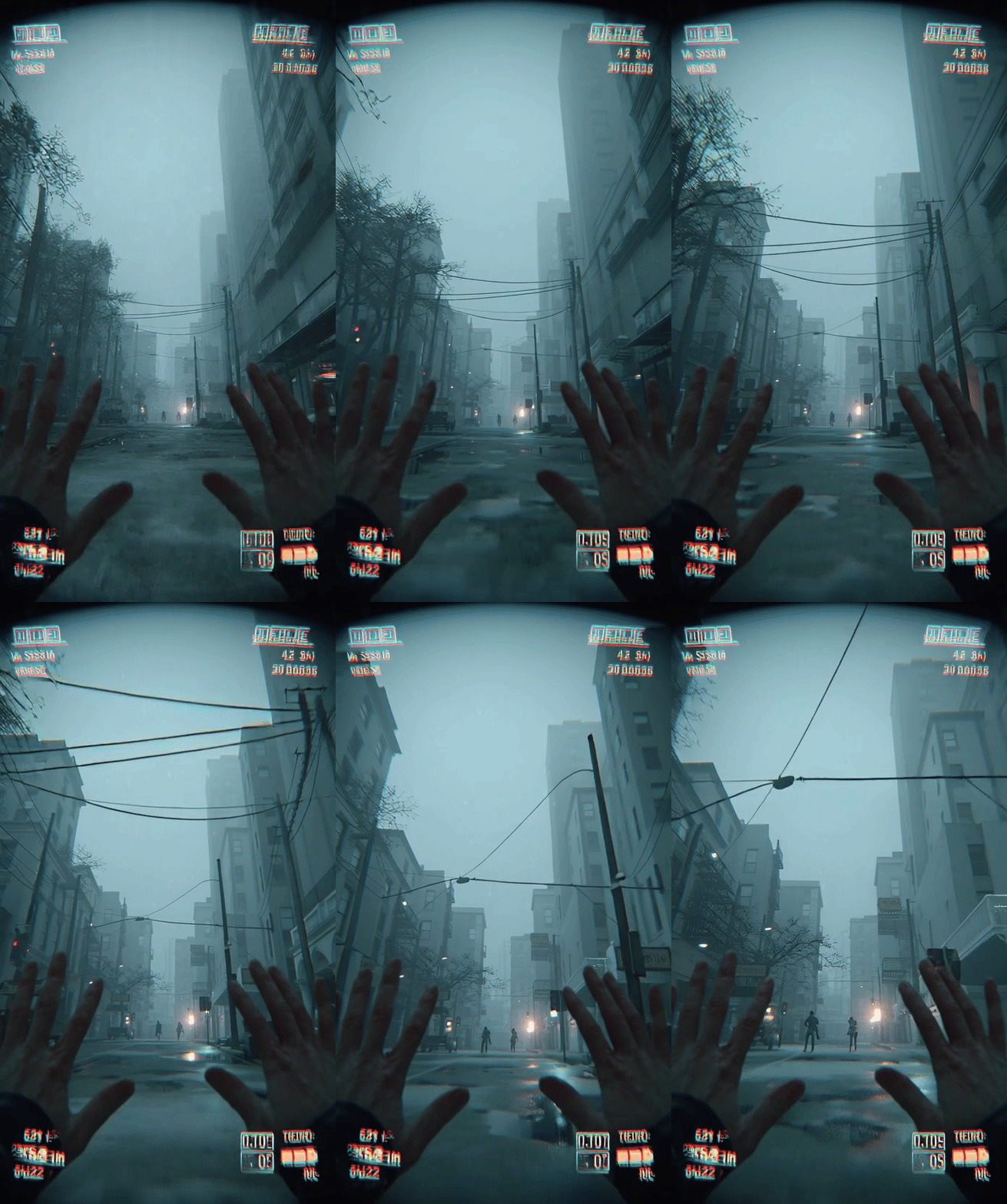
The second state, vigil, is when the screen is on, and the game seems to be going well, but the problem is that we believe that we are the character. We totally identify with it and with the game. We do not see the bigger picture.
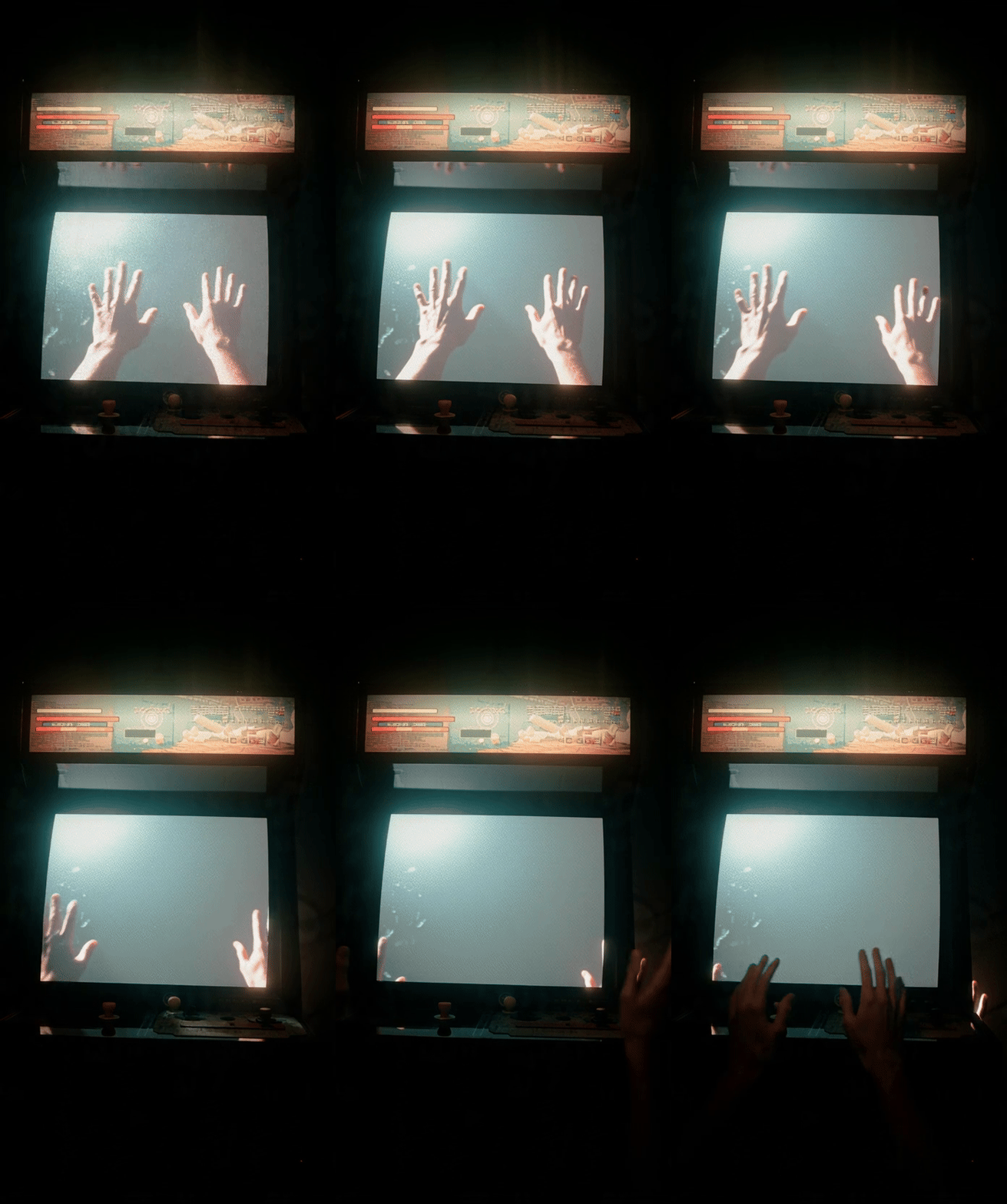
The third state of consciousness is when you realise you are a character playing a game. You simultaneously have information about the character and the character’s environment. You see the bird’s-eye view. You can look around; you know you are not the character in the game.
The fourth state, nous, is understanding the game itself.
Master Michael2 explains that the third state of consciousness is like a snapshot of the fourth state of consciousness. An accumulation of this third state stabilised over a period of time produces NOUS, or enlightenment.
Meditate on this: what else is there to do other than to awaken consciousness?
 I AM NOT THIS BODY
Leave a comment